Work in the future will be a partnership between people, agents, and robots—all powered by artificial intelligence.— Yee et al.,Agents, Robots, and Us: Skill Partnerships in the Age of AI(McKinsey Global Institute, 2025)
One year ago, I founded my company, Altivum™ Inc.
One week ago, theNashville Entrepreneur Center introduced me to the Entrepreneurial Operating System (EOS).
I hope this article finds you early in your entrepreneurial endeavors the way EOS found me, and if not, I hope the ideas I express in this article spark your curiosity enough to make you wonder what the future of EOS will look like.
How Does EOS Fit the Age of AI?
Lets first briefly look at the facts.
The Entrepreneurial Operating System was developed by Gino Wickman in September 2000 though it was not formally named EOS until 2006. This system seeks to give companies a practical way to get what they want from their business by strengthening six core components so the organization becomes clearer, more disciplined, and easier to scale.
The six core components it focuses on are:
- Vision, where everyone is on the same page about where you are going
- People, putting the right people in the right seats
- Data, running the business on objective numbers
- Issues, identifying, discussing, and solving problems to the root
- Process, using documented, followed-by-all ways of working
- Traction, creating discipline and accountability through Rocks and a strong meeting cadence.
Together, these 6 key components of EOS seek to build a healthier and better aligned company that can grow predictably instead of operating in chaos.
Artificial Intelligence broadly promises four improvements to human work: higher productivity, more creativity, better decisions, and a more humane work experience.
Across those four areas, AI has shown the clearest, most measurable impact on productivity and efficiency by turning data into leverage. Controlled experiments find that generative AI tools can cut time-to-complete for knowledge work tasks (like writing and coding) by around 30–50% while also improving output quality.
At the same time, data improves productivity by revealing bottlenecks and waste so that teams can redesign processes, automate low-value work, and allocate resources more intelligently.
See, in practice, high productivity and efficiency almost always ride on the back of good data, not just effort or talent.
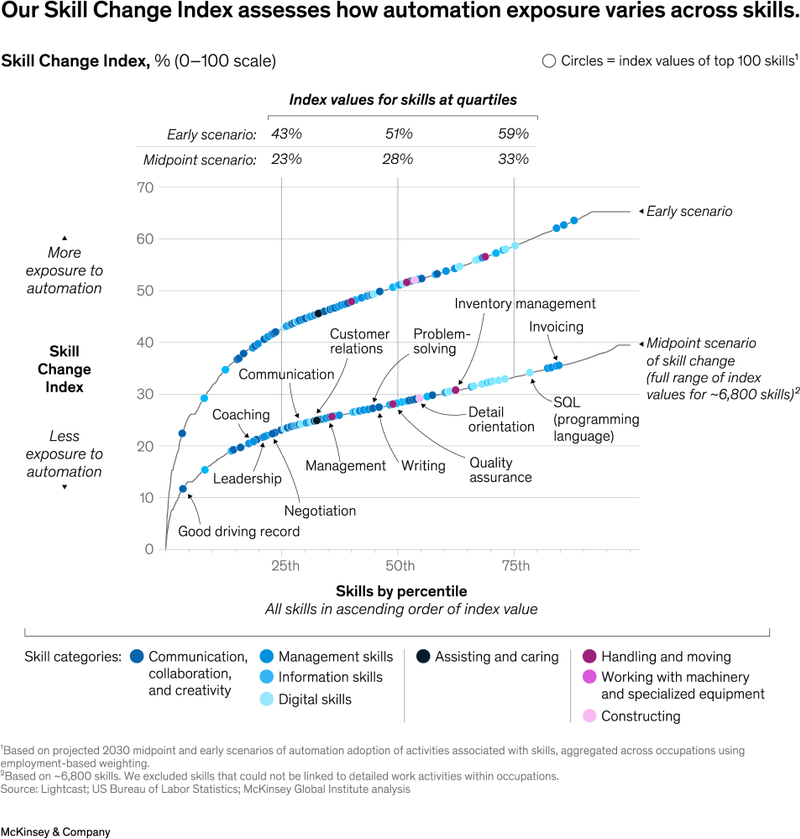
So lets ask the difficult questions: where will AI replace people? Although perhaps that is looking at the glass half empty.
Where are people essential?
These are precisely the questions that I, as an entrepreneur and technologist in the early stages of building my company, am actively looking to answer.
As I start implementing EOS within my company, I can’t help but see AI as an amplifier of what’s already working. Just as EOS provides structure for human decision-making, AI provides leverage for human capability.
The two systems, when integrated thoughtfully, could form a kind of organizational intelligence: one that balances vision and data, intuition and automation, as well as human empathy and computational scale.
For founders like me who are still early in their journey, this convergence feels like a frontier.
EOS gives us a language and framework for clarity, while AI gives us tools to operationalize that clarity in real time. Imagine having visibility not only into your company’s vision, people, and processes but also into the health and momentum of those systems as they evolve.
My company is still young, but I believe the next generation of organizations will be built on this dual foundation: disciplined systems thinking from EOS, and intelligent augmentation from AI.
In order to start putting this into practice, I built EOS x AI Agents.
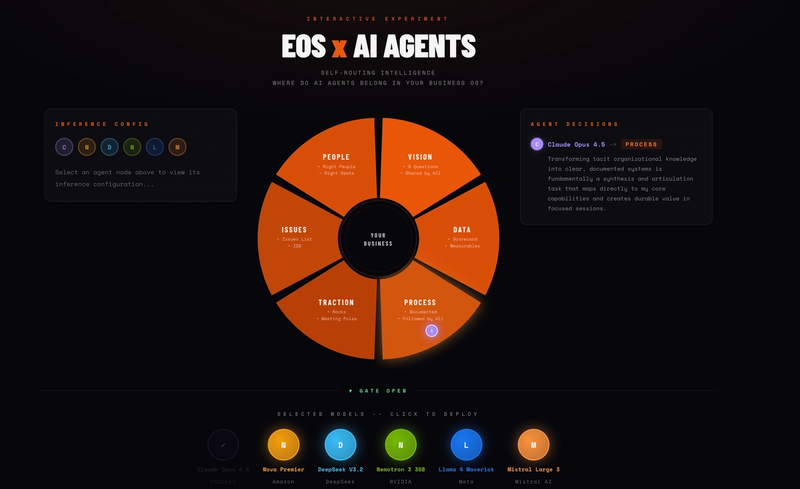
EOS x AI Agents began with a simple question: if EOS helps us put people in the right seats, where do AI agents belong?
That curiosity led me to build live demonstration of how foundation models from different vendors might “find their place” inside the six core components of the Entrepreneurial Operating System.
Picture an EOS wheel come to life: the six core components. Now imagine inviting a half a dozen AI models from across the industry to find their place in that system, each with its own strengths and personality.
As users deploy them, these models analyze their own capabilities and decide where they fit best, ultimately finding their sector within the EOS framework.
The experience is part data visualization, part reflection on the future of work, and part an evaluation of the current state of AI.
Under the hood, this experiment runs on Amazon Web Services (AWS) powered by Amazon Bedrock and connects to a diverse set of foundation models, including:
- Claude
- ChatGPT
- Mistral
- Gemini
- and many more
These tools make it possible to orchestrate multiple AI systems side by side and watch how each interprets the EOS framework differently.
Watching these models distribute themselves feels like observing collaboration in motion. Each model offers its own way of reasoning, its own tone, its own interpretation of Vision, People, Data, and the rest.
But despite their differences, they all adapt to the same operating logic. That alignment hints at how future organizations might blend human intention with machine capability to build businesses that learn and evolve continuously.
What this experiment reveals is less about which model is “best” and more about fit. It’s a visual metaphor for what every entrepreneur, myself included, wrestles with daily: putting the right minds, human or artificial, in the right seats to move the vision forward.
To see this in action click the link:EOS x AI Agents