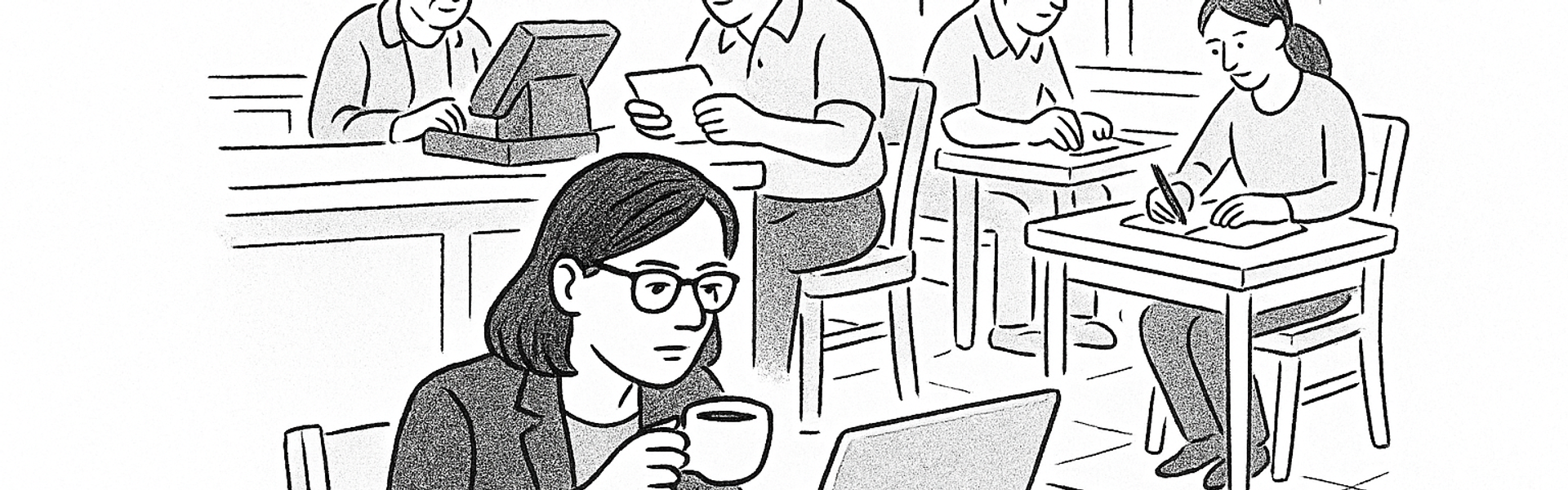
Sarah had always prided herself on being well-informed. As a senior product manager at a leading tech startup in Boston, she started each morning with her carefully curated routine: scan her Discover page on Perplexity while enjoying her Americano, scroll through her X feed of industry leaders and AI researchers, check Hacker News for the latest developments, and skim through her LinkedIn network's insights about the future of artificial intelligence.
AI was everywhere. Her colleagues shared stories of using ChatGPT for brainstorming, Claude for code reviews, and various AI-powered tools for everything from writing emails to generating marketing products. Every team meeting had one goal in mind: what is the latest and greatest AI tool that will help us reach our business goals faster. Adoption rates showed nothing less than exponential growth.
AI was no longer the future; it was now and it was everywhere.
Then came the day she missed her usual train to the office. A car accident on the Tobin Bridge delayed all public transportation leaving Revere. She found herself with thirty minutes to kill in a small coffee shop she'd never noticed before, tucked between a dry cleaner and a family-owned hardware store in an older neighborhood.
The coffee shop was a world unto itself. Martha, the seventy-something year-old owner, struggled with the new point-of-sale system her daughter had installed, muttering about how the old cash register, "never gave her this much trouble." At a corner table, Tom, a local plumber, flipped through printed invoices, manually writing estimates on carbon paper forms. Near the window, Maria, who homeschooled her three kids and a few other neighborhood children, carefully wrote parent-student updates by hand in individual notebooks—10 of them, one for each child.
As Sarah sat with her laptop, intending to review user analytics, she found herself eavesdropping instead. Martha mentioned how her granddaughter kept trying to show her "some robot thing on the computer" that could answer questions, but Martha couldn't see the point when she had her encyclopedia set. Tom had to take a phone call from a customer who wanted to know why his estimates took so long. He explained that he liked to measure twice and cut once, the way his dad taught him. Maria shared her frustration with parents who wanted more detailed and long-term updates about their children, while she believed the personal touch of handwritten notes showed more care.
What Is the Invisible Divide in AI Adoption?
Sarah realized she was witnessing something profound. These weren't people resistant to progress. Martha had eventually accepted the new register, Tom used GPS on his phone for directions, and Maria appreciated the safety features of modern car seats. They were simply living in a different reality than the one Sarah inhabited daily.
When Martha struggled with the register, she didn't think to ask an AI assistant for help. When Tom calculated estimates, he relied on decades of experience rather than AI-powered analytics and estimation tools. When Maria wrote her notes, she found fulfillment in the personal connection that no productivity app could replace.
Sarah's phone buzzed with a Slack message from her team: "The new AI writing assistant is getting amazing engagement—users love it!" She looked around the coffee shop and wondered: which users?
For the first time, she began to question the reports she'd been reading. Yes, 33% of Americans might be "heavy AI users", but what did that actually mean? She thought about her own usage patterns and those of her colleagues. They were definitely in that 33%. But what about the other 67%?
She opened her laptop and started researching with fresh eyes. The data told a different story when she looked beyond the tech industry publications. Only 18% of Americans over 50 use generative AI, and rural workers lag significantly behind urban counterparts in AI adoption. More telling was the discovery that 64% of Americans don't even realize they're using AI-enabled products in their daily lives.
How Did the Mirror Break for Sarah’s Team?
This revelation transformed how Sarah approached her work. She began to realize that her team had been building AI features for tech-savvy early adopters who were comfortable experimenting with new tools. They had unconsciously excluded the vast majority of potential users who might benefit from AI but faced entirely different barriers to adoption.
The next Monday, Sarah walked into the office with a new perspective. When her team proposed another AI-powered feature, she asked different questions: "Would Martha understand this? Could Tom see its value? Would Maria trust it with something as important as caring for children?"
She had discovered something her industry analytics couldn't measure—the vast, unexplored territory beyond the echo chamber walls. For the first time, she understood that expanding AI adoption wasn't about building more sophisticated features for the already converted. It was about building bridges to the coffee shops, repair garages, and daycare centers where the real world was waiting.
Why Does the Feel of Grass Matter in AI Design?
The coffee shop just outside of Boston became Sarah's regular Monday morning spot not just for the surprisingly good house brew, but as her weekly reminder to stay connected to the world beyond her professional bubble. It was her way of "touching grass" in a digital age, ensuring that her team's innovations could eventually bridge the gap between Boston’s AI-saturated reality and the everyday experiences of people like Martha, Tom, and Maria.